Everyday carcinogens
“Teach your children what we have taught our children that the Earth is our mother, Whatever befalls the Earth befalls the sons of the Earth. If men spit upon the ground, they spit upon themselves. This we know - the Earth does not belong to man - man belongs to the Earth. This we know. All things are connected like the blood that unites one family. All things are connected.” Chief Seattle, from Dr David Servan-Schreiber, “Anticancer a new way of life”, Penguin Books 2008, page 112
Everyday we are exposed to man made chemical substances used in the production of food, cosmetics, clothes, furniture, etc. These toxins are found not only in our environment but also in our body, even fetuses are exposed to them. For example, EWG (Environmental Working Group) tested ten infants and discovered that all of them were born with 297 dangerous toxins (such as mercury, pesticides, fire retardants, etc.) in their blood.
Many of such substances are harmful to our health, in fact there is a substantial scientific body of evidence linking them to increased cancer risk as well as other diseases. For example, pesticides have been associated with increased breast, pancreatic and prostate cancer, and Hodgkin Lymphoma particularly in rural areas.
However many of these chemicals, such as 90% of the ones found in personal care and household products, are still not tested for their cancer causing potential - an independent analysis conducted by EWG, discovered that at least 146 cosmetic ingredients may increase cancer risk.
Therefore, while the impact on our body of long-term exposure to many of these combined known and potentially carcinogenic substances is still unknown, we can decrease our exposure to them by taking the following precautions:


Precautions to limit daily carcinogens exposure
-
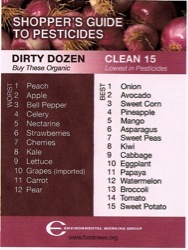
✓Prefer organic food whenever possible - obviously it is best to eat many “standard” fruit and vegetables on a daily basis than occasionally eating organic foods. (see Shopper’s Guide To Pesticides image)
-
✓Read carefully the labels of the cosmetics you use and avoid :
-
➡Lead acetate: reproductive toxin - found in some hair dyes and cleansers in North America, banned in the EU
-
➡Formaldehyde: carcinogen - found in some nail products
-
➡Toluene: possible reproductive or developmental toxin - found in some nail polishes
-
➡Petroleum distillates: possible carcinogen - found in some mascara, perfume and lipstick in North America, banned in the EU
-
➡Ethyl acrylate: possible carcinogen - found in some mascara
-
➡Coal tar: known carcinogen - found in dandruff shampoos, anti-itch creams and hair dyes
-
➡Dibutyl phthalate: endocrine disruptor and possible reproductive or developmental toxin - found in some nail polish, perfume and hair spray
-
➡Sodium lauryl sulfate: skin irritant prone to contamination by a probable carcinogen called 1,4-dioxane - used in many soaps and shampoos for its foaming properties
-
➡Methyl, propyl, butyl and ethyl paraben: endocrine disruptors, known carcinogen, linked to infertility – used as a preservative in cosmetics such as make up, lotions, body wash and shampoos
-
➡Pthalates: linked to cancer, birth defects and reproductive problems, nearly all perfumes contain them
-
➡Salicylic acid: a preservative that has caused birth defects in animals
-
➡Phenol: potential carcinogen and strong irritant
-
➡Aluminium: WHO has linked aluminium to Alzheimer's Disease, linked also to cancer - many deodorants as well as creams still contain aluminium products
-
➡Oxybenzone: mimics the hormone estrogen which doctors have linked to cancer
Visit http://www.householdproducts.nlm.nih.gov and http://www.safecosmetics.org/ for health and safety information on personal care products.
-
✓Avoid perfume, cologne and products with added fragrance. Manufacturers do not have to list ingredients that are not intended to be part of the product, for example they do not need to list the solvents used to add fragrance chemicals, any of these 2600 chemicals can be listed as perfume.
-
✓Prefer wet cleaning to dry cleaning when possible or air out dry-cleaned items for several hours before wearing them as most dry cleaners use a solvent called perchloroethylene which is a know carcinogens and also linked to liver and kidney damage
-
✓Use non-toxic cleaning products which can be purchased at health stores. Alternatively you can use vinegar and water or baking soda to clean. Note that usually when a label contains warning (eg irritant to eyes) it means that the product is toxic. Visit http://www.householdproducts.nlm.nih.gov for health and safety information on household products.
-
✓Do not use scratched Teflon cookware and avoid exceeding certain temperature limits. Prefer stainless steel cookware.
-
✓Avoid indoor air fresheners. Visit EPA (Environmetal Protection agency) http://www.epa.gov for advice on decreasing indoor pollution.
-
✓Avoid heating foods and liquids in plastic containers.
-
✓Buy products with natural fibers, such as cotton and wool, avoid PFCs chemicals which can be found in clothing, furniture, accessories, etc. for a full list visit www. http://www.ewg.org/node/21787 (retrieved 27 march 2009).
from Dr David Servan-Schreiber, “Anticancer a new way of life”, Penguin Books 2008, www.epa.gov and www.ewg.org Retrieved 29 March 2009 (see references)

Key Concepts
-
★Everyday we are exposed to several man made chemicals which are dangerous for our health
-
★By preferring organic food produce and making informed decisions about the products we use every day we can limit our exposure to these substances

References
Andreotti G, Freeman LE, Hou L, Coble J, Rusiecki J, Hoppin JA, Silverman DT, Alavanja MC, “Agricultural pesticide use and pancreatic cancer risk in the Agricultural Health Study Cohort”, Int J Cancer. 2008 Nov 26;124(10):2495-2500
Belpomme D, Irigaray P, Ossondo M, Vacque D, Martin M, “Prostate cancer as an environmental disease: An ecological study in the French Caribbean islands, Martinique and Guadeloupe”, Int J Oncol. 2009 Apr;34(4):1037-44
Dr David Servan-Schreiber, “Anticancer a new way of life”, Penguin Books, Great Britain 2008
Dr Michael Murray, Dr Joseph Pizzorno, Lara Pizzorno MA LTM, “The Encyclopaedia of Healing Foods”, Time Warner Books, Great Britain 2006
Environmental Protection Agency, “The Inside Story: A Guide to Indoor Air Quality”, http://www.epa.gov/iaq/pubs/insidest.html, Retrieved 29 March 2009
Environmental Working Group, Brokaw T, Hager R, Published February 2003, “Scientists Study Contamination In Our Bodies From Products Used Every Day”, http://www.ewg.org/node/15163, Retrieved 29 March 2009
Environmental Working Group, Deardorff J, Published August 2006 “Personal products might not feel all that soothing”, http://www.ewg.org/node/18764, Retrieved 29 March 2009
Environmental Working Group, Gladstone V, Published May 2007, “Safe and unsafe cosmetics”, http://www.ewg.org/node/21632, Retrieved 29 March 2009
Environmental Working Group, Mitchell S, Published December 2002 , “Beauty's Ugly Face”, http://www.ewg.org/node/15094, Retrieved 29 March 2009
Environmental Working Group, “Impurities of concern in personal care products (as of Dec 2006)” http://www.cosmeticsdatabase.com/research/impurities.php, Retrieved 29 March 2009
Environmental Working Group, Edgecomb M,Published 2005, “Toxins in babies' blood prompt call for action”, http://www.ewg.org/node/17699, Retrieved 29 March 2009
Environmental Working Group, Fidelman C, Published 2006, “Montreal group raises alarm over cosmetics”, http://www.ewg.org/node/18522, Retrieved 29 March 2009
Int J Occup Environ Health. 2009 Jan-Mar;15(1):36-42, “Vinyl chloride propellant in hair spray and angiosarcoma of the liver among hairdressers and barbers: case reports”, Infante PF, Petty SE, Groth DH, Markowitz G, Rosner D
McDuffie HH, Pahwa P, Karunanayake CP, Spinelli JJ, Dosman JA “Clustering of cancer among families of cases with Hodgkin Lymphoma (HL), Multiple Myeloma (MM), Non-Hodgkin's Lymphoma (NHL), Soft Tissue Sarcoma (STS) and control subjects”, BMC Cancer. 2009 Feb 27;9:70
Multigner L, Ndong JR, Oliva A, Blanchet P, “Environmental pollutants and prostate cancer: epidemiological data”, Gynecol Obstet Fertil. 2008 Sep;36(9):848-56
Nudelman J, Taylor B, Evans N, Rizzo J, Gray J, Engel C, Walker M, “Policy and research recommendations emerging from the scientific evidence connecting environmental factors and breast cancer”, Int J Occup Environ Health. 2009 Jan-Mar;15(1):79-101
All content and images © 2010 Chiara Rasetto